
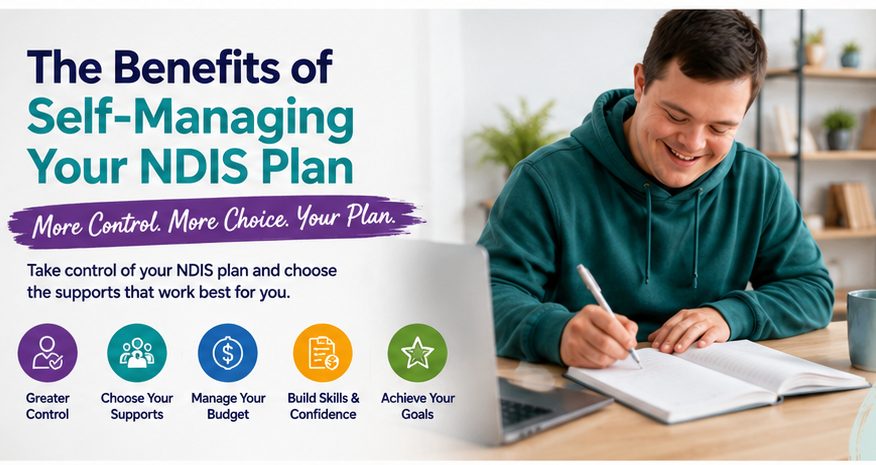
For many participants, the biggest frustration with the NDIS is not knowing whether support can move as quickly as life does. Needs change, providers change, and sometimes the most suitable help is not the easiest to arrange. That is why conversations about the benefits of self-managing an NDIS plan, NDIS options, and NDIS self management matter so much. For the right participant, self-management can offer more control, more flexibility, and a clearer view of how funding is being used.
Self-management is not the best fit for everyone, but it can be a strong option for participants and families who want to take a more active role in organising support. It puts day-to-day decisions closer to the participant, rather than leaving them entirely in the hands of a plan manager or the NDIA. That shift can make a real difference when timing, provider choice, and personal preferences matter.
What NDIS self management means in practice
With NDIS self management, the participant takes responsibility for managing some or all of their plan funding. That usually includes choosing providers, agreeing on service arrangements, checking invoices, paying providers, and keeping records. It also means making sure spending matches the goals and budget categories in the plan.
In practical terms, self-management gives participants more say in how supports are delivered. Instead of being limited to providers that use specific payment systems or arrangements, participants can often choose from a wider pool, including smaller businesses and independent workers. For many people, that alone changes the experience of using the NDIS.
Self-management can apply to an entire plan or just selected supports. Some participants use a mix of options, with one part self-managed and another part plan-managed or agency-managed. That flexibility is worth remembering because the decision does not always need to be all or nothing.
More choice over providers
One of the clearest benefits of self-managing an NDIS plan is broader provider choice. When funding is self-managed, participants are not restricted to registered NDIS providers for those supports. They can often work with unregistered providers too, as long as the service is appropriate and the spending meets NDIS rules.
This can be especially useful in areas where provider availability is limited, or where families have found someone who is a strong personal fit but is not formally registered. A participant might prefer a local therapist with availability, a support worker recommended through their network, or a specialist service with a niche skill set. Self-management can make those options possible.
Choice also matters beyond availability. It can be about cultural fit, communication style, language, scheduling, or accessibility. For participants who need supports to work around school, work, family life, or complex care needs, being able to choose the right person or business can improve consistency and trust.
Greater flexibility in how support is arranged
The NDIS is structured around budgets and categories, but real life does not always fit neatly into administrative systems. NDIS self management often gives participants more flexibility in arranging support in ways that suit their routine.
That might mean negotiating service times directly, organising short-notice changes, or combining supports in a way that makes the day easier to manage. It can also mean finding providers who are willing to tailor their approach rather than offering a fixed service model.
For families and carers, this flexibility can reduce some of the friction that comes with coordinating multiple services. When support is easier to adapt, it becomes easier to build arrangements that are practical and sustainable, not just technically approved.
Better visibility over spending
Another major advantage is budget awareness. When participants self-manage, they usually have a closer view of what has been claimed, what has been spent, and what remains available. That level of visibility helps with planning and can prevent budget surprises later in the plan period.
For some people, this makes the NDIS feel more transparent. They are not waiting for someone else to interpret their spending or explain where funds have gone. They can track patterns, notice if a provider is charging more than expected, and make early adjustments if support use is changing.
This visibility can also support stronger decision-making. If a participant sees that one support is underused while another is becoming more important, they are in a better position to respond quickly, seek advice, or prepare for a plan reassessment with clearer evidence.
Faster decisions and fewer delays
Administrative delays can affect access to support, especially when invoices, approvals, or provider arrangements need to move quickly. Self-management often reduces some of those bottlenecks because participants are managing payments and decisions directly.
That does not mean every process becomes simple, but it can mean fewer layers between the participant and the service. If a provider sends an invoice, the participant can review and pay it. If a support arrangement needs to change, the participant can discuss it directly with the provider. For people who are confident in handling these tasks, that speed can be a practical advantage.
This is often one of the less discussed benefits of self-managing an NDIS plan. The value is not only in freedom of choice, but in the ability to keep supports moving without unnecessary hold-ups.
Stronger ownership and skill-building
For some participants, self-management is about more than administration. It can support confidence, independence, and capacity-building. Managing a budget, selecting providers, comparing services, and keeping records are all practical skills that can strengthen a person’s involvement in their own supports.
That sense of ownership can be significant. Rather than feeling like support is being arranged around them, participants may feel more actively involved in shaping what works. Families and carers can also gain a better understanding of service quality, pricing, and planning, which can improve future decisions.
This will not be the main reason everyone chooses self-management, and it should not be romanticised. The paperwork is real, and not everyone wants or needs that responsibility. Still, for participants who are ready for it, self-management can be empowering in a very practical way.
Potential cost advantages
Self-management may create opportunities to use funding more efficiently, particularly when participants can compare providers and negotiate rates within NDIS pricing rules and reasonable market expectations. Sometimes, a participant can find a provider who offers the same quality of support at a more suitable price or with service terms that better match their needs.
That can help stretch a budget further across the life of the plan. It may also allow participants to prioritise value in a broader sense, looking not only at hourly rates but also at reliability, travel arrangements, cancellation policies, and responsiveness.
Still, this benefit depends on careful decision-making. The cheapest option is not always the best one, and poor-quality support can cost more in the long run if it leads to inconsistency or unmet needs.
The responsibilities that come with NDIS self management
Self-management offers advantages, but it also comes with work. Participants need to keep accurate records, store invoices and receipts, monitor budgets, and make sure spending aligns with NDIS requirements. They also need to understand what can and cannot be claimed.
That responsibility is where self-management becomes less suitable for some people. If administrative tasks are likely to become overwhelming, or if there is limited time, confidence, or support to manage them, another option may be more appropriate. A plan manager can reduce that burden while still allowing more provider choice than agency management.
It is also worth noting that self-management requires judgment when choosing providers. Participants are taking a more direct role in checking whether a provider is a good fit, whether pricing is reasonable, and whether services are delivered as agreed. Tools that help compare providers by category, location, accessibility features, and service focus can make that process more manageable.
Who self-management may suit best
NDIS self management often suits participants or nominees who are comfortable with paperwork, confident communicating with providers, and interested in making direct decisions about supports. It can work well for families who want flexibility, for participants in areas with fewer registered providers, and for people who value having a wider range of service options.
It may also suit participants who already have informal supports around them, such as family members, carers, or support coordinators who can help with decision-making even if they are not handling the plan themselves.
On the other hand, if managing invoices, records, and compliance feels like an extra stress rather than a benefit, self-management may not be the best choice right now. Some people start with plan management and move into self-management later, once they better understand how their plan works.
Making provider choice easier
One practical challenge with self-management is finding the right providers in the first place. More choice is only helpful if participants can compare services clearly and contact suitable providers without wasting time. That is where a disability-specific directory can be useful, especially when searching by support type, location, and the details that affect fit, such as language, access methods, and service specialties.
For participants exploring self-management, finding providers who match their goals and preferences can make the extra responsibility feel worthwhile. The more informed the choice, the better the support arrangement is likely to be.
Self-management is not simply about taking on more admin. At its best, it is about bringing decisions closer to the participant, making support more responsive, and creating room for services that actually fit the person using them.
Share on