
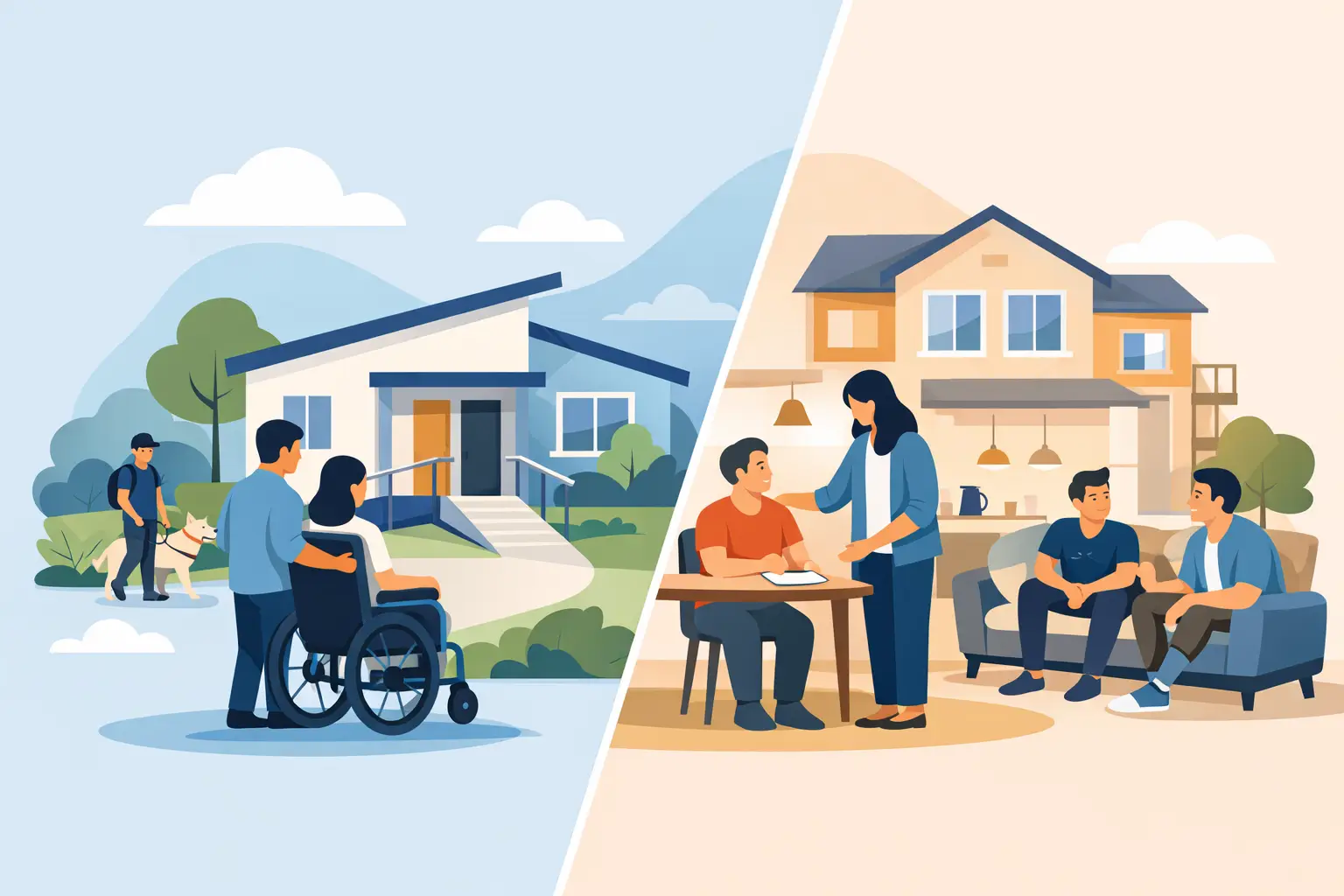
If you are comparing SDA vs SIL housing, you are probably already dealing with one of the harder parts of the NDIS - working out not just what support is available, but where someone can live safely, comfortably and with the right level of independence. These two terms are often mentioned together, which makes them easy to confuse. But they are not the same thing, and understanding the difference can make provider conversations much clearer.
SDA vs SIL housing: the short version
SDA stands for Specialist Disability Accommodation. It refers to the physical home itself - the building or dwelling designed for people who have very high support needs or extreme functional impairment.
SIL stands for Supported Independent Living. It refers to the support services a person receives in the home, such as help with personal care, cooking, cleaning, medication, or daily routines.
A simple way to think about it is this: SDA is about the property, while SIL is about the support delivered inside it. Some people have funding for both. Some have one and not the other. That is where a lot of confusion begins.
What SDA housing actually covers
Specialist Disability Accommodation is funding for housing that has been specially designed or modified to suit participants with significant functional impairment or very high support needs. These homes may include features such as wider doorways, accessible bathrooms, assistive technology, backup power, reinforced ceilings for hoists, or layouts that allow support workers to assist more safely.
SDA is not available to every NDIS participant. It is generally intended for a smaller group of people whose housing needs are directly linked to the impact of their disability. Approval depends on whether the NDIS considers SDA to be reasonable and necessary, and whether it represents better value than other home and living options.
There are different SDA design categories, including Improved Liveability, Fully Accessible, Robust and High Physical Support. The right category depends on a person’s needs, not on what vacancies happen to be available. That distinction matters, because a home that looks suitable on paper may still be a poor fit if the design category does not match the participant’s support requirements.
SDA funding usually pays for the specialist housing cost, not everyday living expenses. Residents still need to contribute to day-to-day household costs such as groceries, utilities and a reasonable rent contribution, depending on their situation.
What SIL housing means in practice
Supported Independent Living is not a type of building. It is funded support for daily living, often delivered in a shared home, but sometimes in an individual arrangement. SIL is designed for people who need regular support throughout the day, overnight, or both.
This can include assistance with getting dressed, showering, preparing meals, managing medication, using public transport, or building skills to live more independently. In some homes, support workers are present around the clock. In others, supports may be more limited and tailored to a person’s routine.
SIL funding is also not automatic. It usually applies where a participant needs a significant level of ongoing support at home. The NDIS will consider how much support is needed, when it is needed, and whether shared or individual supports are the most reasonable option.
Even though people often say "SIL housing", SIL itself is not the housing. That phrase is common in everyday conversation because providers may offer a house with SIL supports already in place. But technically, the funding is for support, not the bricks and mortar.
SDA vs SIL housing: why people mix them up
The overlap is understandable. Many participants live in homes where both SDA and SIL are involved. For example, someone might live in a purpose-built accessible property and receive daily support from support workers in that same home. In practice, it can feel like one package. Under the NDIS, though, these are separate funding categories with different purposes.
That separation matters when you are looking at vacancies. A provider may advertise an SDA property, but that does not mean SIL is included. Another provider may offer SIL supports in a regular home that is not SDA enrolled. A participant could be eligible for SIL but not SDA, or for SDA but with a different support arrangement.
This is one reason it helps to ask detailed questions early. If a listing says a home is available, families and support coordinators need to know whether they are looking at specialist accommodation, funded in-home supports, or a combined arrangement that involves more than one provider.
Can you have SIL without SDA?
Yes. Many participants receive SIL in homes that are not SDA properties.
For example, a person may live in a shared rental house or another mainstream housing arrangement and have funded support workers assisting with daily living. The home itself may not include specialist design features, but the person still needs substantial support to live as independently as possible.
This can be a suitable option where a participant’s main need is support with daily tasks rather than specialised physical design. It may also be the more practical pathway if SDA funding has not been approved.
Can you have SDA without SIL?
Yes, that can happen too.
Some participants live in SDA and receive other types of supports instead of SIL, such as drop-in assistance, community access supports, informal care from family, or a different mix of funded supports. A person may need the design features of the property but not require shared rostered support throughout the day.
This is a good example of why there is no single home and living pathway that suits everyone. Two people may both live in SDA, but their support models can look very different.
How eligibility usually works
SDA and SIL each require evidence, and the evidence needs to match the funding being requested.
For SDA, the focus is generally on the participant’s functional impairment, housing needs, and why specialist accommodation is required. Reports from occupational therapists, allied health professionals and other clinicians often play an important role.
For SIL, the focus is usually on daily support needs. The NDIS may look closely at what assistance the participant needs each day, what informal supports are available, and whether support can be shared with other residents.
Because these decisions are separate, approval for one does not guarantee approval for the other. That can be frustrating for families who assume the supports will automatically follow the property, or vice versa. It is one reason many people work closely with a support coordinator, allied health professional or housing specialist when preparing evidence.
What to look for when comparing providers
When you are reviewing SDA vs SIL housing options, the most useful question is not just "Is there a vacancy?" It is "Is this the right match?"
A good match usually comes down to three things: the property, the supports, and the household fit. The property needs to suit the participant’s mobility, sensory, behavioural or physical support needs. The support model needs to align with funded hours and real daily routines. And if the arrangement is shared, the people living there need compatible lifestyles, communication styles and preferences.
Provider transparency matters as well. Families should be able to ask who delivers the SIL supports, whether the home is SDA enrolled, what design category applies, whether there are overnight staff, how vacancies are filled, and what costs sit outside NDIS funding. If answers are vague, it can be a sign to keep looking.
For many people, practical details shape success more than brochure language does. Who responds if a participant needs help overnight? Can the person keep seeing their existing therapists and support workers? How far is the home from family, day programs, work, or community activities? These are the details that often determine whether a placement feels sustainable.
Choosing between options with confidence
If you are still weighing up SDA vs SIL housing, it may help to separate the decision into two parts. First, ask what kind of home the person needs. Then ask what kind of support the person needs within that home.
That approach can make complex choices feel more manageable. It also helps when searching a directory or speaking with providers, because you can filter options based on the participant’s actual goals and funded supports rather than broad labels.
On Disability Providers, families and support coordinators often look for listings that make these distinctions clear so they can compare accommodation features, support models and provider details without wasting time on unsuitable options.
The best housing decision is rarely about finding a vacancy quickly. It is about finding an arrangement that supports safety, dignity, routine and choice - and that gives the person a genuine chance to feel at home.
Share on